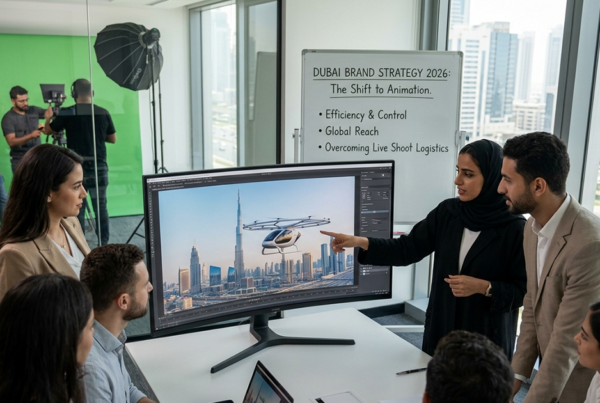
Dubai brands with a mass-market product, a physical retail presence or a trust-building goal should weight their budget toward TV commercials (40–60%), while brands focused on measurable conversions, e-commerce or younger audiences should weight toward digital ads (60–80%). Most established brands need both the real question isn’t “TV or digital,” it’s “what job is each format doing.”
Why This Question Keeps Coming Up
Marketing directors in Dubai are under pressure to justify every dirham of spend. Digital ads promise clean dashboards impressions, clicks, cost-per-acquisition while TV commercials feel harder to measure. That’s led many brands to shift budget almost entirely to digital. But performance data from UAE media buyers tells a more nuanced story: TV still delivers reach and credibility that digital struggles to replicate, especially in a market as brand-conscious as the UAE.
What TV Commercials Do Better
1. They build trust fast. UAE consumers, particularly in the 35+ demographic and in B2B decision-making circles, still associate TV presence with legitimacy. A brand that runs a commercial on a recognized channel signals scale and stability something a scrolling Instagram ad can’t do as effectively.
2. They reach broad, passive audiences. Not everyone in Dubai is actively searching or scrolling. TV catches people during downtime at home, in waiting rooms, in hotel lobbies when they’re not in “ad-blocking” mode mentally.
3. They support big moments. Product launches, Ramadan campaigns, national day tie-ins, and major brand repositioning all benefit from the “event” feel that a TV commercial creates. Digital ads can amplify that moment, but they rarely create it on their own.
4. They have a longer creative shelf life. A well-produced 30-second commercial can be cut down into 15-second and 6-second digital versions, extending the value of one production budget across multiple channels.
What Digital Ads Do Better
1. Precision targeting. You can reach a 28-year-old fitness enthusiast in Jumeirah Lake Towers specifically something TV cannot do.
2. Real-time optimization. Budgets can shift mid-campaign based on what’s converting, which protects spend from underperforming creative.
3. Lower entry cost. A brand can test messaging with a few thousand dirhams before committing to a full production budget.
4. Direct response. For e-commerce, lead generation, or app downloads, digital ads offer a clearer, faster path from ad view to action.
A Practical Budget Framework for Dubai Brands
- Startups and DTC brands: 80% digital, 20% TV/brand film focus spend on performance, but keep one strong brand video for retargeting and social proof.
- Established retail, F&B, or hospitality brands: 50/50 split TV and outdoor build the brand story, digital drives footfall and bookings.
- Real estate, finance, and B2B: 60% TV/brand video, 40% digital high-trust purchases benefit from credibility-building formats, with digital used for retargeting warm leads.
- FMCG and mass consumer brands: 60% TV, 40% digital broad reach still wins when the goal is category dominance, not a single conversion.
The Production Advantage Most Brands Miss
The smartest Dubai marketing teams don’t treat TV and digital as separate production jobs. A single, well-planned commercial shoot can be edited into a full TV cut, a square social version, a vertical Reels/TikTok cut, and a set of static assets pulled from the footage multiplying the value of one production budget across every channel. This is where working with a video production partner who understands both broadcast standards and social-platform specs pays off, rather than commissioning separate shoots for each format.
Common Mistakes to Avoid
- Treating TV as a one-off. A single airing rarely moves the needle frequency matters and a media plan needs to account for that.
- Reusing a TV cut as-is on social. Platform-native editing (captions, pacing, vertical framing) significantly outperforms a straight re-upload of a broadcast ad.
- Ignoring measurement entirely for TV. Brand lift surveys, website traffic spikes during airtime and search volume increases can all be tracked to tie TV spend to results.
- Over-indexing on digital because it’s “measurable.” Measurable isn’t the same as effective vanity metrics like click-through rate don’t always translate to brand growth.
FAQ
Is TV advertising still relevant in the UAE in 2026?
Yes. UAE TV viewership remains strong among older demographics, high-income households and during major cultural moments like Ramadan and National Day, making it effective for brand-building even as digital consumption grows.
How much does a TV commercial cost to produce in Dubai?
Production costs vary widely based on concept, cast, locations, and post-production needs a simple studio-based commercial costs significantly less than a multi-location shoot with talent and VFX. Getting a scoped quote from a production company is the best way to budget accurately.
Can one video production budget cover both TV and digital?
Yes this is increasingly the standard approach. A single production day can generate a TV cut, multiple social edits and static content, reducing overall cost per asset.
The Takeaway
Don’t ask “TV or digital” ask “what is this budget supposed to achieve.” Brand trust, mass reach and category leadership favor TV conversions, precision, and speed favor digital. Most Dubai brands need a deliberate mix of both, produced smartly enough that one shoot serves multiple channels.
Looking to plan a TV commercial that also works across digital and social? Zaini Media produces broadcast-ready commercials designed to be repurposed across every platform your brand needs.